Creating a Body That Feels Joy: On self-massage, softening, and coming back to life

A close friend asked me recently — "What do you mean when you say self-massage creates a body that feels joy?"
I had been sharing with her my thoughts on how self-massage helps us to feel again especially when it comes to feeling joy. And her question made me reflect. Because most people have never thought about self-care this way. We think about it in terms of looking better, losing weight, reducing stress. All of which are real and valid. But joy? That feels like a different conversation entirely.
And yet — for me, it's the most honest answer I have for why I do this work.
The women who ask "where is my joy?"
This question tends to find the women who care the most.
The hardworking, multi-passionate ones who want to live deeply and fully and meaningfully. Who pour enormous energy into their work, their families, their relationships, their responsibilities — wanting to do everything well, wanting to show up fully, wanting to matter.
So much goes out. And at some point, without quite noticing when it happened — you look up and ask:
But where is the joy in this?
I know this feeling. I've gone through phases of it myself.
And what's funny — and very telling — is how I respond to it.
Like a problem to be solved.
What do I need to do to fix this? What's missing? Is my schedule too packed? What has been happening? What must I add, change, rearrange, optimise — to feel more joy?
There's almost a righteous frustration that comes with it. A kind of indignation. I should be enjoying this. I'm doing so many things that are supposed to feel good. Why isn't it landing?
I've had this conversation with friends who are similarly wired — Type A, deeply passionate about their work and their lives, high achievers who genuinely love what they do. And I can sense the same frustration underneath their words.
How come I'm not enjoying this more?Where has the joy gone?
We approach it the way we approach everything — with analysis, with action plans, with a determination to figure it out and fix it.
But joy isn't a problem to be solved. It's a state to be restored.
And that's a very different thing.
What this practice has given me — personally
I want to share something personal here, because I think it matters.
I discovered deep lymphatic self-massage during one of the most challenging periods of my life. I was going through a breakup. I was feeling fearful about so many things. Uncertain. Lacking confidence in myself and in the future.
And what this practice gave me — week after week, as I showed up for myself with my own hands — was something I didn't expect.
I could literally see the changes in my body. Week on week, it got more sculpted. Slimmer. My skin tone was improving. I was looking better and feeling better.
And precisely because this was happening during a period of such difficulty and uncertainty — to see those changes, and to know that I had created them, with my own hands, through my own consistency and care — that was the biggest gift I could have given myself.
It wasn't just a physical transformation. It was proof. Proof that I was capable of change. Proof that I could show up for myself even when life was hard. Proof that my body was capable of something beautiful — even in the middle of something painful.
That proof became confidence. And that confidence began to radiate into every other area of my life.
The armour we wear
Here's what I've come to understand — from my own experience, and from the women I work with.
When we live in a state of chronic overwhelm, we build armour.
Against disappointment. Against pain. Against being hurt or let down. Against dropping the many balls we are perpetually juggling. We tighten up. We brace. We hold everything together through sheer force of will and tension.
And the armour works — up to a point. It keeps us functioning. It keeps us upright.
But here is the thing nobody tells us about armour:
The same walls that protect us from pain also keep the good things out.
To feel joy — truly, deeply, in the body — is also to feel sadness. To feel hope. To feel tenderness. To feel all of it. These things come through the same channel. You cannot selectively numb the difficult ones without also numbing the beautiful ones.
So we walk through our days — protected, capable, exhausted — and joy arrives. And we are simply too tense to receive it.
A joke lands and we barely laugh. Someone is kind and it doesn't quite sink in. A beautiful moment passes and we register it intellectually but don't feel it in our bones.
We are present. But we are not there.
The car running at 250km/h
I think of it like a car that has been running at 250km/h for so long that 240km/h feels like rest. If you ask it to slow to 240, you think — I'm fine. This is normal. I'm not even going that fast. But what if the natural speed of a human life — a life that can actually be felt — is closer to 50 or 80km/h?
Most of us have been so far above that threshold for so long that we've forgotten what it feels like to move at a pace where we can actually receive life as it comes.
This is the thing about chronic overdrive — it becomes invisible to us. We're so used to operating at a certain speed that we don't even notice the tension anymore. It's just how life feels. This is just how I am. But it isn't.
It's how your nervous system has learned to cope with an unsustainable pace. And it can change.
What self-massage does — the Science
When you massage your own body — gently, consistently, with a little oil or cream and your own two hands — something happens that no amount of thinking can replicate.
Your muscles soften. Your breath deepens. Your nervous system shifts — gradually, measurably — from fight-or-flight into rest and restore.
Cortisol — your stress hormone — drops. Oxytocin — the bonding hormone, the love hormone — rises. Inflammation reduces. Sleep improves. Your body moves out of survival mode and into something closer to its natural state.
And the lymphatic system — your body's waste disposal and detox system — begins to flow more freely. Fluid retention reduces. Metabolism improves. Your cells renew more efficiently. Your skin starts to glow.
This is not separate from the emotional experience. This is the same thing, expressed through the body.
Because when the body is in a state of chronic stress — the lymphatic system stagnates. Waste builds up. The face looks puffy. The waistline thickens. The body feels heavy and stuck.
And when the body begins to clear — everything begins to move again. Physically and emotionally.

The subconscious shift nobody talks about
There are so many ways we try to change our mindset consciously. Manifestation. Affirmations. Journalling. Trying to change our limiting beliefs. All of these have their place.
But what I've found — and what I witness again and again in the women I work with — is that self-massage does something different. It changes things subconsciously. In a way that is gentle. Sustainable. And completely without force.
Over weeks and months, something quietly shifts in how you relate to yourself. The inner critic softens. The harsh patterns in your thinking — the ones you've been trying to change through willpower for years — begin to loosen.
Not because you forced them to.
But because you are showing up for yourself. Every day. With kindness. With your own hands.
And you are treating yourself the way you would treat someone you love.
The change to your attitude toward yourself — the change to your relationship with yourself — it happens as a natural byproduct. It is nothing you need to force.
Over time, you just notice: I'm much kinder to myself. And it feels like something that simply emerged, rather than something you had to work for.
The open palm
My Reiki teacher used to talk about this — the importance of openness to receiving. Of being open to something being different. Of allowing things to be good.
And I think about this in terms of the body too.
Think about someone who is hopeful. Someone who genuinely believes that things can be good. Notice their body. Their fists are a little more open. Their palms are a little more relaxed. There's a softness in how they hold themselves.
Now think about someone who is bracing. Waiting for the next thing to go wrong. Their shoulders are up. Their jaw is tight. Their hands are clenched.
Self-massage creates the first state — physically. First in the body. And the emotional openness follows.
You don't have to force yourself to think more positively. You don't have to believe first. You just have to soften first. And let the rest come.
It's like a chicken and egg thing. Either you force your mind to open up — which takes enormous effort and rarely sticks — or you massage your body to naturally open up, and the mindset follows. Same destination. A gentler, more sustainable route.
What becomes possible when the body softens
When your baseline shifts — from 250km/h to something closer to 80 — life doesn't change. But your capacity to receive it does.
The little good things start landing. A kind word actually reaches you. A funny moment actually makes you laugh — properly, from the belly. A piece of good news settles into you instead of passing over the surface.
You have that openness. That capacity. That space inside you for good things to find their way in.
And this extends far beyond joy in the moment.
When the body is more rested, you think more clearly. You make better decisions. You trust your instincts more.
And when things don't go well — because they won't, always — you have something that wasn't there before. A loop that brings you back faster. A kinder inner voice that says: I got through things before. I was capable of creating positive change in my own life. I can do this too.
That is resilience. Not forced. Not performed.
Built slowly, gently, through the consistent act of caring for yourself.
The most holistic thing I know
I've been in healthcare for over ten years. I've studied aromatherapy, lymphatic drainage, lifestyle medicine, wellness coaching. I have tried many things — for myself and with my clients.
And I keep coming back to this.
There are too many benefits to not do this.
You get the physical changes — the sculpting, the reduced puffiness, the improved skin, the supported weight loss, the better sleep and energy and immune function.
You get the emotional changes — the self-compassion, the confidence, the resilience, the openness.
You get the mental changes — the clarity, the better decisions, the kinder inner voice.
And underneath all of it, you get something harder to name but perhaps most important of all:
A body that can feel joy again.
Not because joy wasn't there. But because you finally created the conditions to receive it.

Creating a body that attracts Good Fortune
In Japanese there is a beautiful concept — 幸運体質 — a body constitution that naturally attracts good fortune. Not luck in the lottery sense. But the kind of quiet fortune that comes when you are open, rested, and receptive. When you move through life at a pace that allows you to notice and receive what it is offering.
I believe self-massage is one of the most direct paths to creating this in yourself.
Not because of magic. But because of what it does — to your nervous system, your lymphatic flow, your relationship with your own body — all of which quietly determines your capacity to feel, to receive, and to live fully.
A body that is nourished and open is a body that good things naturally find their way to.
Confidence gained from seeing to believing
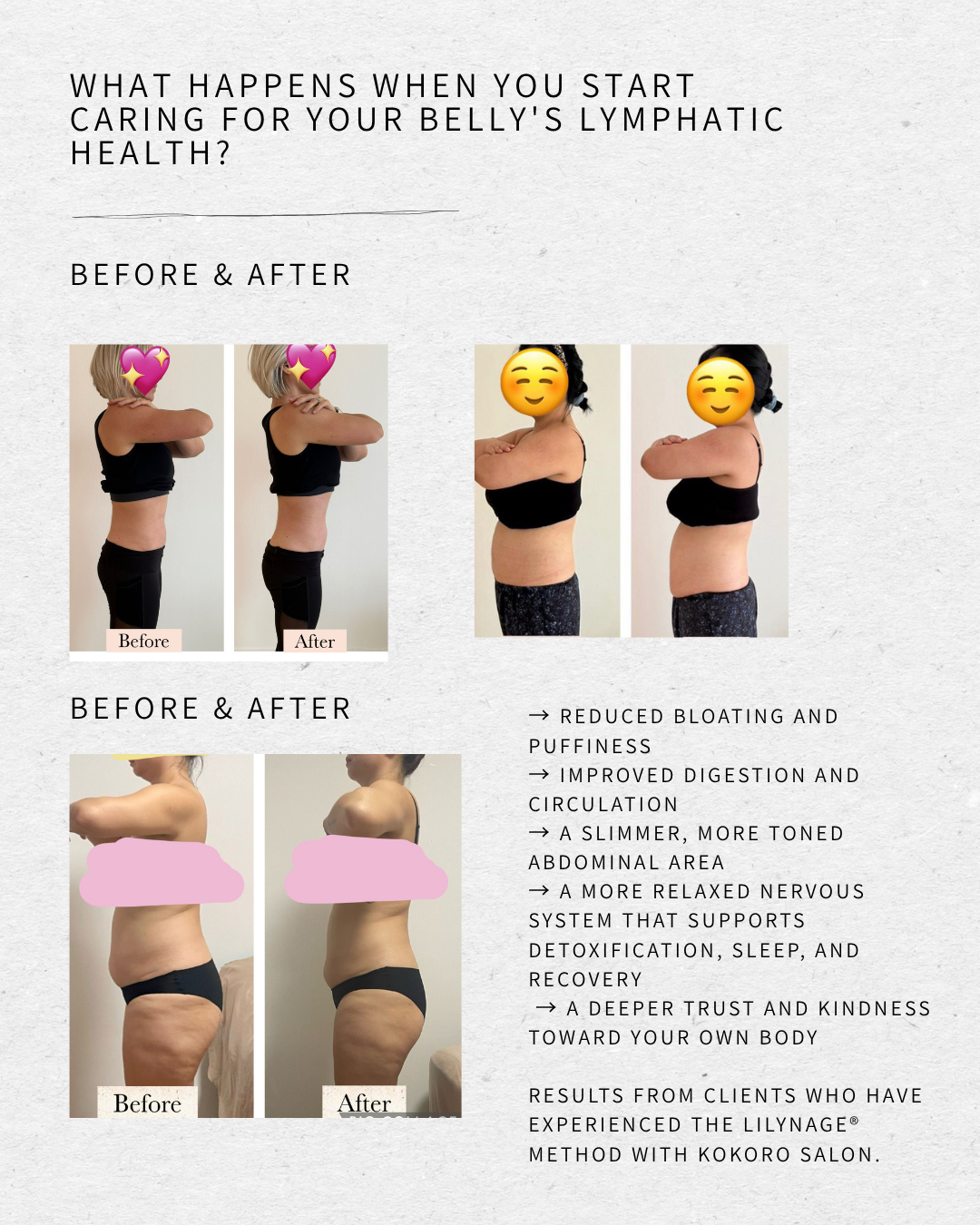
Confidence gained from seeing to believing the changes in your body — radiates into all parts of your life.
This is the truth I keep returning to. The one that I lived personally during the hardest period of my own life. The one I witness in the women I work with.
You see the change. You believe change is possible. And that belief — grounded in physical, visible, real evidence — quietly changes how you show up. In your relationships. In your work. In your willingness to try things. In your capacity to love yourself even when things don't go perfectly.
It starts in the body. And it radiates outward.
Where to begin
If any of this is resonating — if you recognise yourself somewhere in these words — here is the simplest possible first step.
Not a program. Not a commitment. Not another thing to add to your list.
Just this:
Place your hands on your face. Or your neck. Or your abdomen.
Use a little oil or cream if you have it.
Move slowly. Breathe.
Two minutes.
That's the beginning.
Not of a wellness routine. But of a different relationship with yourself. One that — over time, gently, without force — creates a body that can feel the joy that was always there, waiting for you to be open enough to receive it.
Curious where to begin?
We have the 7 Day Energy Reset Challenge.
Join in for the upcoming October Come Home to Your Body Wellbeing Workshops in Singapore.
Or reach out directly to info@kokoro-salon.com — I would love to hear where you are on your journey.