How to Find Courage When You're Exhausted and Overwhelmed

Have you ever wanted to try something new, something different — and felt so afraid you didn't know where to start?
You want more courage. You want to take that step. You feel that that to do hard things — to take bold steps, to pursue what we really want — we need to be a certain way. But something holds you back.
So what do you do?
Most of us do the same thing. We tell ourselves to push harder. Be braver. Be more disciplined. More motivated. More like someone who seems to have it all together.
We white-knuckle our way forward — and when it's still so hard, we quietly wonder: what is wrong with me?
And this can be so exhausting and frustrating.
But what if that's the wrong question entirely?
What If We Didn't Need More Courage — What If We Needed More Support?
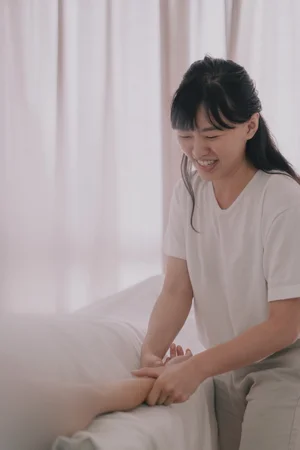
Here's what I know from working with women's bodies — and from my own journey as a physician and holistic wellness coach.
All of that straining, pushing, and forcing? It doesn't just exhaust you mentally. It lives in your body.
So much of the tension we carry isn't random. It comes from trying too hard. From pushing ourselves to break out of our comfort zone too harshly, or putting so much pressure on ourselves to change, to be different, to be more — that our bodies brace against it.
When we're in a constant state of stress and self-pressure, our muscles tighten. Our shoulders creep up. Our jaw clenches. Our belly contracts. The body holds on — because that's what bodies do when they feel under threat.
And here's what most people don't realise: that physical tension directly blocks your lymphatic flow.
The lymphatic system — unlike your heart — has no pump. It moves through the rhythm of your breath, your movement, your muscle contractions and releases. When you're chronically tense, chronically in fight-or-flight, that flow slows. Fluid stagnates. Your body holds on — to waste, to inflammation, to weight that won't shift no matter what you try.
Add to that the cortisol flooding your system from ongoing stress, and you have a body that is quite literally working against the changes you're longing for. Against the energy you're trying to find. Against the lightness — physical and emotional — that you wish for a healthier way of being.
So the question isn't how to push harder or force more out of yourself.
The question is: how can we change our approach towards living a larger, more expanded life — while respecting our bodies and caring for ourselves more gently?
A Conversation That Moved Me
Recently, I was sitting with a self-massage student and client — a woman I've been working with as part of an aromatherapy case study — and she said something that stopped me.
She'd been reflecting on how she wanted more courage in her life. More energy. Less sluggishness. The ability to take proactive steps toward the things she actually wanted.
And then she said something that made my heart sing a little. She told me she'd finally started to understand, from the inside, what I'd been telling her all along — that the answer wasn't to force more bravery or willpower, but to come back to fundamentals first. Care for the body. Tend to the emotions. Build from there.
I'd been saying it to her for a while. But she put it more beautifully than I ever had:
"It's not about forcing myself to be brave. It's about asking — how can I support myself better, so that what I want comes more naturally?"
That's the thing about real learning. Sometimes someone gives back your own words, transformed — and suddenly you hear them differently too.

The Foundations of Courage
What I've come to believe — through my own journey, and through working with my clients — is that courage isn't something you summon through sheer force of will.
It's something that emerges when you create the right conditions for it.
Think about how our bodies change when we focus on fundamentals. Nourishment. Rest. Movement. Detox. Flow. We become more stable. More energised. More ourselves.
Courage works the same way.
Here are the foundations I've come to see as essential:
1. Support your physical body first. Sleep, nourishment, movement, and self-massage. When your body is resourced, you have energy. When you have energy, action feels possible. This isn't superficial — this is a fundamental concept of health.
When you're tired, your emotions are all over the place. It's hard to feel positive, hopeful, or brave when your physical body isn't cared for. So this is always the first place we tend to. Before anything else.
2. Tend to your emotional body. We cannot logic our way out of emotional depletion. We need to process, release, and feel held. Regular practices that help you discharge stress — whether that's journaling, bodywork, breathwork, or simply being heard — matter enormously.
Emotional health directly affects how confident and resourceful we feel. And here's something worth remembering: we also have hormonal cycles. If you're in the midst of a low phase — check in with yourself. Are you in your premenstrual phase, when progesterone naturally causes you to feel more bloated, fatigued, and low in energy? In those moments, it's not weakness. It's biology. Take the time to comfort and care for yourself. When you feel held and tended to, the positivity and resourcefulness naturally return.
3. Love yourself enough to know that what you value and desire — matters. Not the surface kind of self-love. The deeper kind — where you look at your own dreams and desires and, instead of quietly dismissing them, you allow yourself to take them seriously.
So many of us have dreams. But somewhere along the way, we start to wonder — do I actually deserve this? Is this even possible for someone like me? We look at others who seem to be living the life we want and tell ourselves: maybe that's just their story. Their fate. Their luck. Maybe it's not meant for me.
But what if it is?
Self-love, in this context, means choosing to believe that your desires exist for a reason. That they were placed in your heart for you — not as a reminder of what you can't have, but as a signpost toward what's possible. You don't have to be certain. You just have to be willing to stop ruling yourself out.
4. Get clear on your values. When you know what you stand for — what truly matters to you — you're no longer drawing only on willpower. You're drawing on something much deeper. Clarity of values is quiet, steady courage. It becomes an anchor when fear is loud and doubt creeps in.
(Here is a journal post on reconnecting to your Why)
5. Ask for support. From others. From something greater than yourself. Courage was never designed to be a solo act.
The more expanded a life you want to lead, the more you also need to expand your capacity for living it. And that means expanding your support network — the village that holds you. Reaching out, leaning on community, asking for help, praying — these aren't signs of weakness. They are signs that you're ready to receive more.
6. Learn to love yourself regardless of outcome. This one, I think, is the deepest and most transformative of all.
What if you could take a bold step — and know, truly know — that you will love yourself even if it doesn't work out? That you could fall short, miss the mark, not get the outcome you wanted — and still hold yourself with tenderness? That you tried. That you were brave enough to want something and reach for it. And that alone is worth loving yourself for.
This is what makes risk feel safe enough to take. This is what allows you to try again.
I think about athletes like Shohei Ohtani. To become one of the greatest baseball players alive — both as a pitcher and a batter — he has practised, failed, tried again, and failed some more, more times than we can count. Greatness, at its core, is a numbers game. You have to be willing to take the long view.
And the only way to take the long view is to have your own back. Unconditionally.

The Courage to Dream Bigger
When all of these foundations are in place — even partially, even imperfectly — something shifts.
But I want to be honest with you, because I think it matters.
Even with all the foundations in place, there are days — sometimes stretches of days — where dreaming big feels genuinely terrifying. Where I don't dare let myself want something too much, because what if it's not possible? What if I'm disappointed? What if I get my hopes up and it just... doesn't happen?
I know this spiral. It’s something I experience time and again and am also learning to practice getting out of.
And what I've come to understand is this: there are cycles.
In life, in courage, in dreaming. We all move through phases where the fear is louder and phases where the hope is stronger. This isn't weakness — it's human. It's the rhythm of a real life.
The dreams that stick around through those cycles — the ones that keep coming back even when you've tried to talk yourself out of them — those are the ones worth paying attention to.
Those are the ones that are meant for you. And the journey toward them is deeply meaningful. It shapes you in ways you can't yet see.
Your Environment Is a Form of Support
So how do we support ourselves through the cycles?
Your environment matters more than you think. Not just your physical space — though that matters too — but the people in your orbit. Who you keep close. Who you go out to meet. Who you choose to listen to, including on social media.
Here's something I find delightful and true: your dreams might be idealistic to some people, and completely realistic to others. It just depends on who you're talking to.
So if you have a big dream — talk to big dreamers.
Surround yourself with people who have already done something that once seemed impossible.
They will show you what's possible. They'll show you how or perhaps introduce you to people who have done something similar. And rope in the doers too — the practical ones who can help you figure out the actual steps.
Environment is a form of support. Tailor it, redefine it, refine it every step of the way.
And Then — Take It Easy On Yourself
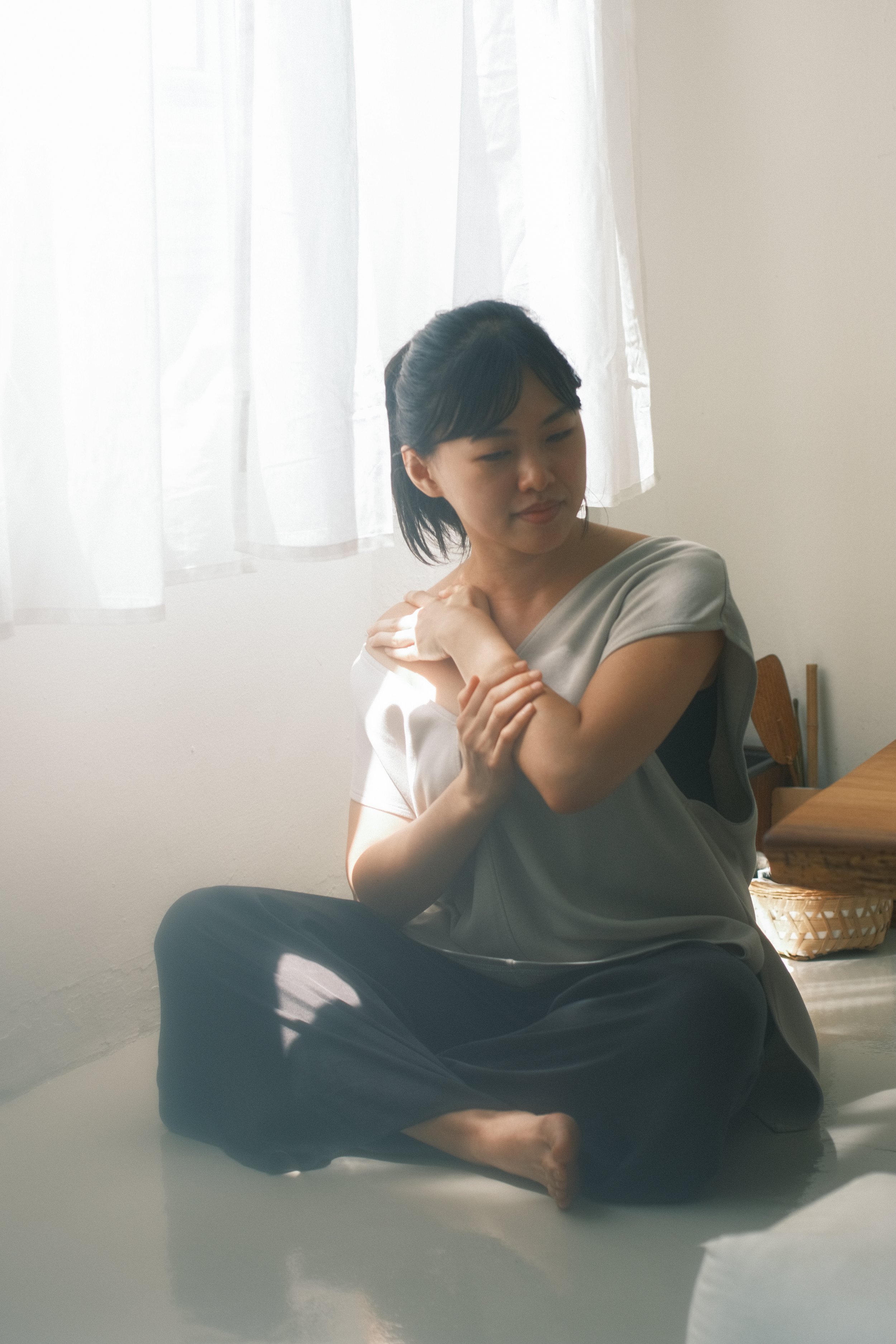
Remember: there are cycles. You are already trying so hard.
If you’re in the down part of a cycle take the time to simply acknowledge that and allow yourself to just be present there.
If it’s a cycle, the upstroke and upwave will always come.
So in the meantime, take a rest. Give yourself a huge hug. Go out and replenish yourself in whatever means necessary. Step into nature. Call a loved one to cry and whine. Watch a wonderful K-drama. Cry your eyes out. Laugh like crazy with your favorite people. Eat amazing food that you absolutely love.
And then feel yourself slowly, gently, find your groove again.
Because you will. You always do.
Coming Home to Yourself
When we learn to support the body — to soften the tension, restore lymphatic flow, calm the nervous system — something remarkable happens. The heaviness lifts. Energy returns. And the things that felt impossible start to feel within reach.
This is why, for me, deep lymphatic self-massage isn't just a beauty or wellness tool. It's a practice of coming home to yourself. Of creating the internal conditions where courage — and change — can actually take root.
So the next time you feel stuck, or sluggish, or like you just don't have the courage you need — before you push harder, I invite you to pause and ask:
How can I support myself better?
That one question might change everything.
.
.
.
This is the heart of the work I do with women in my Radiant Body Renewal 1:1 programs and also 1:1 work— redefining your internal and external environment, so that who you want to become comes with greater ease.
If you feel called to explore this work together, I'd love to connect.
[Get in touch → HERE]